OBJECTIVE MORALITY
A Universal Standard
Of Right And Wrong

What is right? What is wrong? These questions haunt every society, yet the answers often shift with culture, law, opinion, or convenience. In a world where morality has become relative, flexible or politically enforced, we must ask: is there a deeper standard - one that transcends power and preference.
Objective morality says yes.
It holds that moral principles are not invented but discovered. Rooted not in belief or tradition, but in Natural Law. These principles apply to all people equally, at all times, because they arise from the reality of what it means to be human. They are not dictated by rulers, majority, or ideologies, but by Truth, Autonomy, Harm, and Justice – the four unshakable, unchangeable principles of a truly moral life.
This chapter lays that foundation. Not as a theory, but as a compass, one that points to what is right, not just what is accepted.
The idea that morality is objective raises a deeper question:
Where does it come from? What is it exactly?
If morality doesn’t come from opinion, law, or culture, then how is it created?
The answer is both simple and radical:
Morality isn’t created. It’s just there. Always was. Just like gravity. Ready to be discovered.
We didn’t create magnetism, or the value of pi, or the way heat rises – we discovered them. Morality belongs to the same category: something true before we named it, and still true if we deny it. Just like the laws of physics, morality reveals itself through the observation of consequence. We observe it not in theory, but discover it through the results of our actions. Touch a flame, and you get burned, regardless of what you believe. Stand in the rain, you get wet. Initiate force, lie, coerce, or steal, and you introduce disorder, no matter what your culture, god, or government says. These outcomes are consistent because morality is rooted in how reality works.
To say morality is discovered is to say it is real. Not subject to opinion, not dependent on legislation, and not altered by time or trend. When we learn something is immoral, we haven’t changed the morality of the act, we’ve simply seen it more clearly. Take slavery, for example. It didn’t start out moral and later became immoral. It was always immoral – we just failed to see it. It’s not that we decided slavery was wrong. It’s that we finally recognized it had always been wrong. The suffering, the domination, the destruction of autonomy. It was immoral before it was illegal. It was immoral before it was unpopular. We didn’t invent that. We realized it. We discovered it.
This discovery principle is what separates objective morality from cultural norms, moral relativism, or utilitarian shortcuts. If we confuse morality with popularity, we end up defending atrocities. If we confuse it with law, we excuse injustice. But if we root it in consequence, in truth, in reality, we find something unshakable.
We find something real.
And if morality is real, it must follow real rules. Which leads us to the next question: what governs those rules?
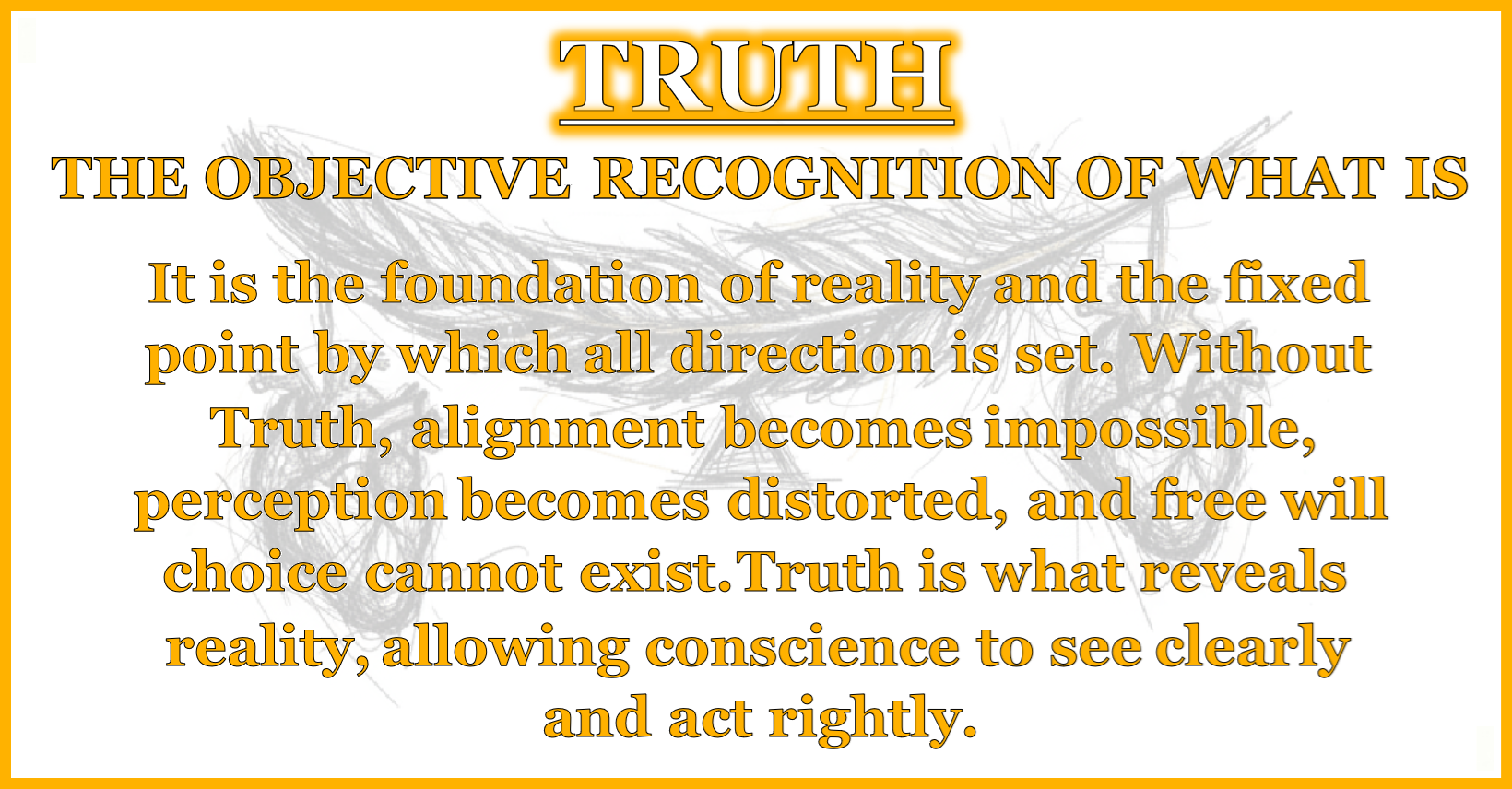
The truth principle maintains that morality is inseparable from truth, as deception is a primary means by which harm is inflicted. Any deliberate attempt to obscure or distort reality in a way that misleads others is immoral because it compromises their ability to make informed choices. This principle ensures that morality is based on objective reality rather than manipulated or misinformation.
Truth is not merely a value, it is a prerequisite for moral action. A person cannot choose rightly if they cannot see clearly. Morality, therefore, demands that the information we act upon reflects reality as it is, not as someone wishes it to appear. When people are misled, they lose the ability to act with autonomy. Without truth, autonomy becomes hollow, and justice becomes impossible. This is why the Truth principle stands as the first of morality’s four foundational pillars: because it enables the others.
Lies, fraud, and misinformation are immoral because they lead individuals to act against their best interests or create false realities that result in harm. Deception robs people of their ability to make fully informed decisions, leaving them vulnerable to manipulation and exploitation. A clear example is financial fraud, where a scam artist deceives an elderly person into giving up their life savings under false pretences. The victim, acting on false information, suffers harm due to the deception, making the act immoral.
But this extends far beyond personal deceit. If one person can be misled into self-harm through the lies of a scammer, what happens when the same scam is broadcast to entire nations? What happens when that lie leads not to lost savings, but to war? On a systemic level, governments, corporations, and media institutions routinely engage in mass deception. They distort truth to justify genocide, to sell products, to manufacture fear, or to hide corruption. The scale of harm multiplies when the lie becomes official policy, accepted as truth by the unaware. Just like the elderly person misled by a scam artist, the people who support such policies do so in good faith, trusting what they were told, unaware that the foundation of their choices made, their consent, their support, and their participation, was built in lies. Turning a scam artist in to a mass manipulator, conning millions into wilful murder through distorted reality. This makes deception not just immoral – it makes it dangerous.
Consider the tobacco industry’s campaign throughout much of the 20th century. Around the world, cigarette companies, backed by complicit regulators, knowingly suppressed evidence of health risks. They didn’t just deny the danger, they actively reversed it. Advertisements featured actors dressed as Docters, confidently recommending specific brands. One slogan even read, “Your doctor recommends you smoke Camel.” Millions believed it, trusting the white coat and the clipboard more than their own instincts.
Objective morality is based on what is, not what is believed or portrayed. Truth is not subjective. It is fixed, independent of opinion, perception, or desire. Like gravity, it exists whether we acknowledge it or not. And like gravity, its effects are real.
Morality depends on truth because actions depends on perception. Distort perception, and you distort morality at its roots. If morality begins with informed choice, then truth becomes the rock upon which our actions are built. Truth is not optional. It is essential. In any moral system, truth is sacred. Not because it is nice, but because without it, morality cannot exist.
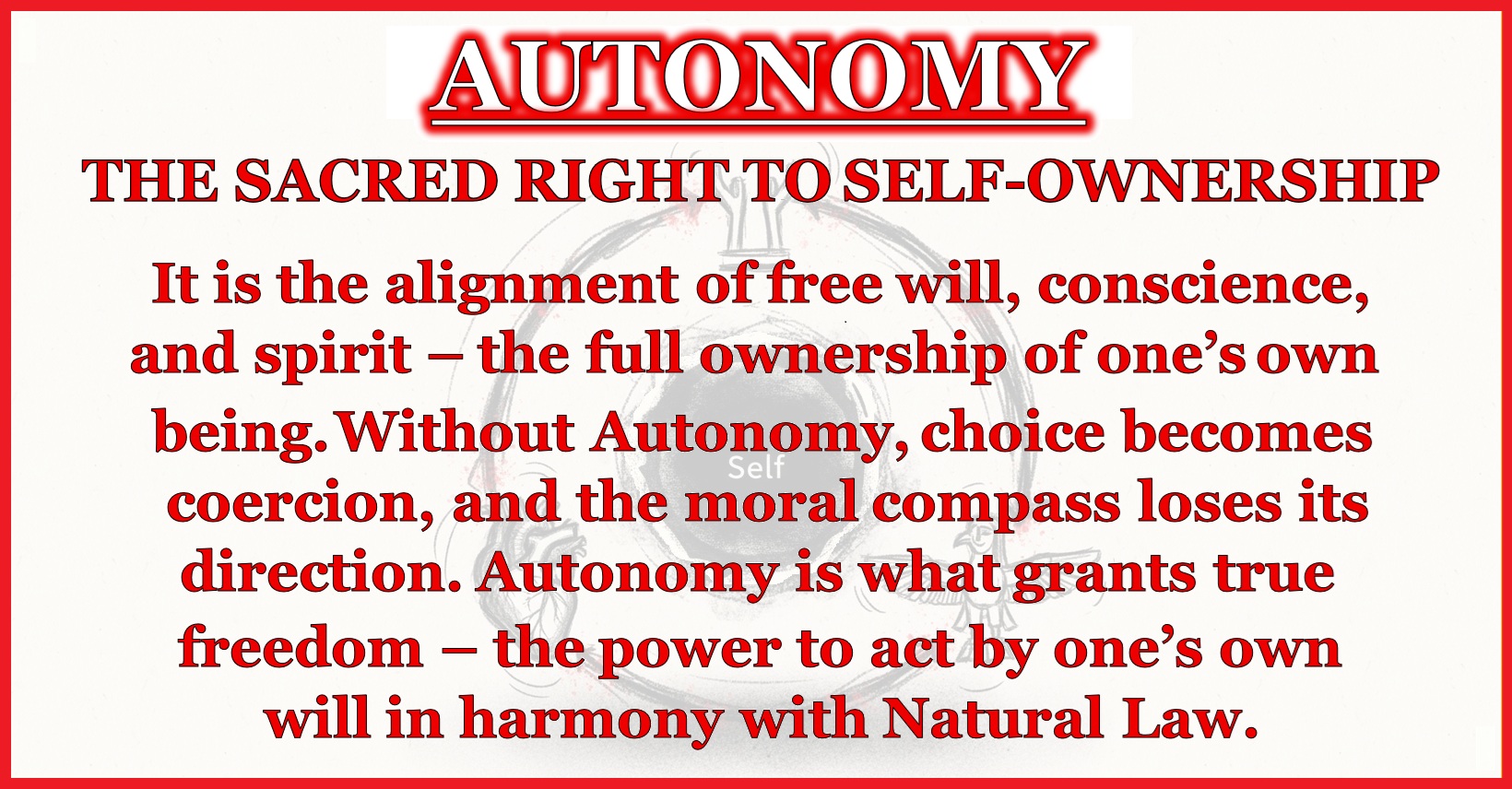
The Autonomy principle ensures that morality is maintained through the protection of individual freewill choice – that individuals are the rightful owners of their own lives. It asserts that every person inherently possesses the primary right to make freewill decisions about their own body, mind, time, energy and actions – provided they do not infringe upon the equal rights of others.
By upholding autonomy, objective morality ensures that individuals are not subjected to external control, force, or manipulation that overrides their personal freedom. This principle recognizes the inherent dignity and worth of each individual life and their right to self-determination.
For an action to be moral, it must first be chosen freely. Therefore, any coerced action – whether motivated by fear, force, or manipulation – is immoral because it strips away moral agency and the freedom to make choices. A person complying under threat is not acting ethically; they are reacting out of survival. In this sense, autonomy is the space in which morality happens. Take it away, and only obedience remains – not virtue.
Without autonomy, morality cannot exist. True autonomy begins with self-ownership. You cannot claim to own anything – not property, labor, or even basic rights – if you do not first and fully own yourself. We will put this under light later in the book, but to understand the autonomy principle, we must understand that autonomy means the moral recognition that your body is your domain. Your thoughts are your territory. Your choices are your responsibility. And anything less is subjugation.
Modern systems violate autonomy constantly – not through chaos, but through control. While laws and cultural traditions often claim to act in the best interest of individuals or society, they frequently impose restrictions that violate personal autonomy. For instance, laws that mandate medical procedures without consent. Such laws disregard individuals’ rights to make choices about their own body, regardless of how well-intentioned these laws may be. The autonomy principle rejects the notion that authority figures or institutions have the right to override personal freedom under the guise of the greater good. Personal autonomy itself is the greater good, as it ensures that individuals retain control over their own lives without unjust interference. Autonomy is not granted by governments, institutions, or laws. It is not just a mere privilege – it is a condition of moral existence. So ask yourself: how can any morality be considered just, if it begins by violating the very rights it claims to protect? Or more simply, if personal freedom must be taken away in order to protect it, what exactly is being protected?
Licensing, mandates, censorship, surveillance, and coercive schooling are all presented as “safety measures.” But beneath the language of “care” lies a constant undermining of the individual’s right to choose freely.
By emphasizing freewill as a necessity for morality, the Autonomy principle ensure that ethical decisions respect individual rights rather than being dictated by arbitrary rules or social pressures. Without autonomy, morality ceases to be about right and wrong and becomes a matter of control – where those in power dictate choices rather than individuals making them for themselves. True morality upholds voluntary exchange, where all interactions are entered into freely, and all parties retain their ability to choose without fear of external force or deception.
Autonomy does not give the freedom to harm – it represents the freedom to live without being harmed. It draws the line where guidance ends and force begins. The boundary of one person’s autonomy extends only to the edge of another’s, and this applies equally to all. No one’s freedom justifies the restriction or denial of another’s. To cross that line is to enter the realm of violation – where influence becomes pressure, and choice becomes control. That is where harm begins. The moment you use your Autonomy and free will to violate that of another is to create harm.
Because autonomy is required for informed, voluntary action, it is inseparable from both truth and justice. A person misled cannot consent. A person coerced cannot be held accountable. A person silenced cannot be free. To respect autonomy is to recognize that moral action begins with permission – not permission from without, but from within.
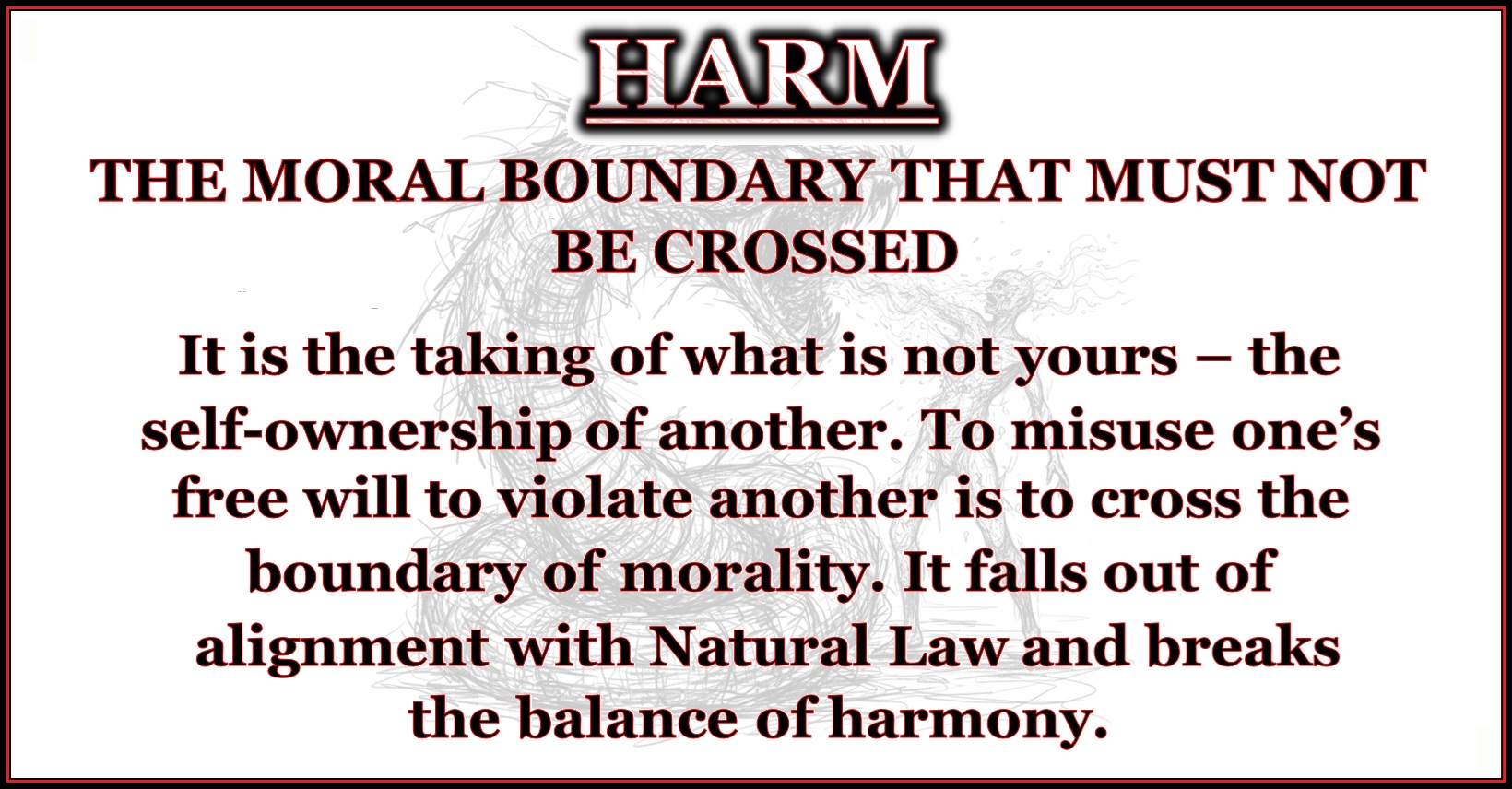
The harm principle establishes that morality is defined by the prevention of unjustified harm. It holds that an action becomes immoral when it inflicts harm to another person without their informed consent. Harm can take many forms, physical, emotional, psychological, economic, but its defining trait is that it violates the boundaries of another’s well-being, safety, or autonomy.
Our moral journey begins with Truth, but it is the Harm Principle that defines the boundaries of immorality. Unlike opinions, beliefs, or cultural traditions, harm is not subjective. It is measurable. A broken bone, a nervous breakdown, an emptied bank account, or a shattered reputation. These are not interpretations. They are consequences – visible outcomes of invisible transgressions. Harm is therefore the universal thread that runs through every true moral violation. Put simply, if no harm is done, no violation has occurred. But where ever harm exists without consent, so does immorality.
To fully understand what counts as harm, we must also be clear about what does not. The harm principle does not concern itself with hurt feelings, disagreement, or offense. These are inevitable byproducts of a free society. Being offended is not the same as being violated. Moral harm involves the crossing of a boundary, where another person’s body, mind, or property is directly or indirectly damaged, manipulated, or stripped away without voluntary agreement.
Consent plays a crucial role in this framework. Some actions may cause pain or difficulty, yet still remain moral if entered into voluntarily and with full understanding. Surgery, for instance, causes harm in a controlled and consented context. But the same act, performed without permission, becomes assault. Even in commerce, a financial agreement can be fair when entered into freely, but the same exchange, under duress or deception, becomes exploitation. Likewise, sexual relations between consenting adults may involve physical intensity – even pain – without being immoral. But without consent, any sexual act becomes rape. It is not the action alone that defines morality, it is whether harm is inflicted unjustly.
Morality is not a matter of intention alone – it is a matter of result. An act that leads to destruction, suffering, or control over another cannot be made moral by a good excuse or popular vote. It is the natural consequences that defines the truth of the act.
By grounding morality in harm, this principle strips away the arbitrary moral systems built on tradition, authority, or preference. It exposes the delusion that “legal equals moral” and challenges the assumption that cultural norms are ethical simply because they are widely accepted. The harm principle transcends these illusions by asking a simple question: who was harmed, and did they consent.
This is the absolute rule of ethical action. No title, belief, or justification can override that.
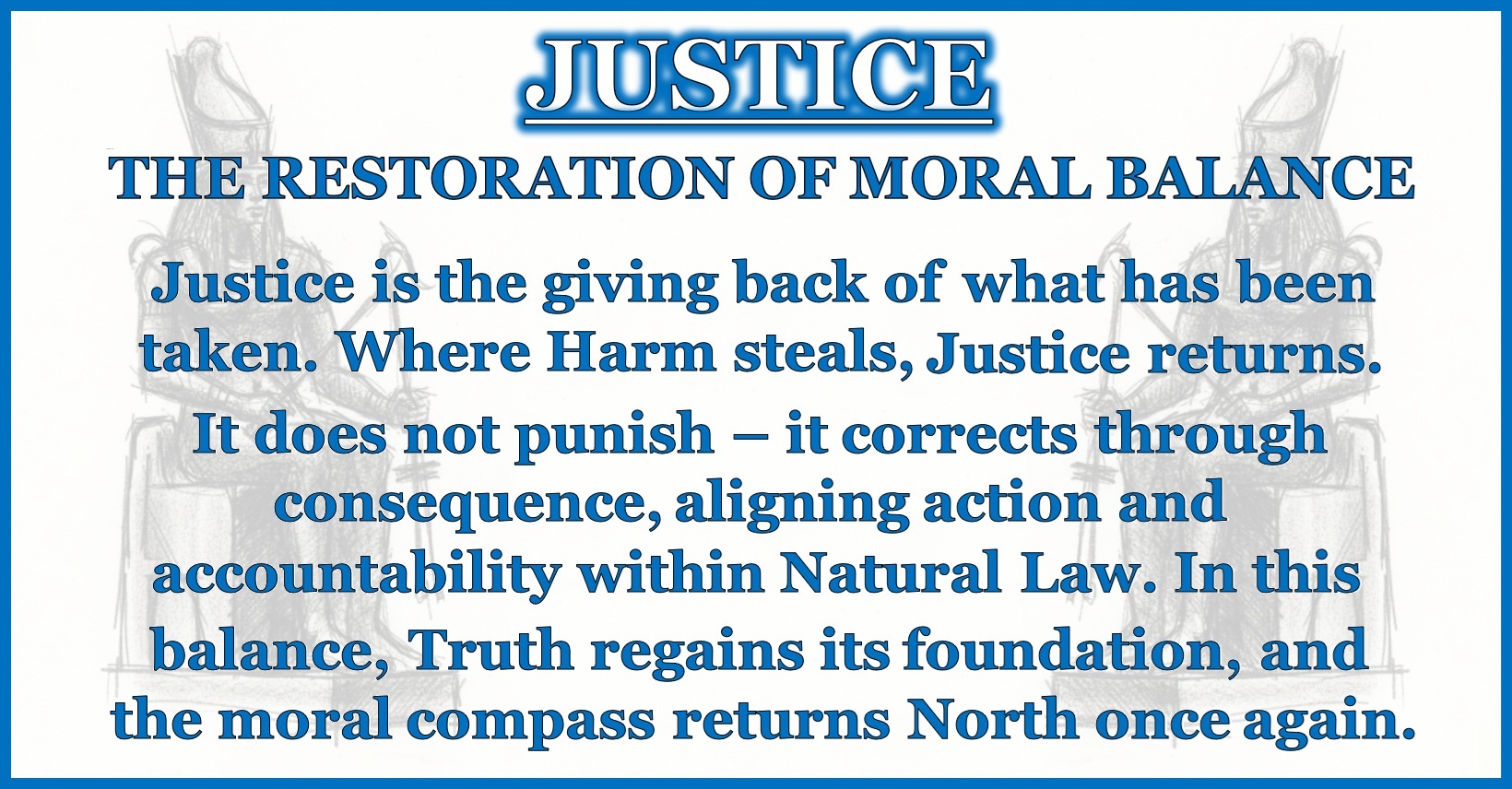
The justice principle holds that morality demands the restoration of balance after harm occurred. It is not rooted in vengeance, but fairness – where consequences are proportional, and responses aim to repair rather than punish. Justice is what morality requires after harm has been done. It is the response principle.
True justice does not seek to satisfy anger or impose cruelty. It seeks to restore what was lost, repair what was broken, and hold individuals accountable in a way that aligns with ethical consistency. This principle safeguards against the abuse of power by demanding that all responses to harm remain anchored in fairness – not subjective feelings, emotional retaliation, or shifting social standards.
Justice, in moral terms, is not merely the enforcement of law – it is the restoration of moral order. The justice principle provides a moral foundation that prevents individuals and institutions from using punishment as a tool of control rather than as a means of restoring balance and ethical accountability.
A just response restores the autonomy or property that was taken, heals what was damaged, or establish accountability when restoration is no longer possible. Accountability is an essential part of this restoration. The person who causes harm must take moral responsibility. Not simply as a form of punishment, but as recognition of the imbalance created. Without acknowledgement of wrongdoing, restoration is incomplete. Accountability reaffirms the dignity of the victim and reinforces the moral order that was violated. For example, if someone steal from another person, justice is not about punishment for its own sake. It is about returning what was stolen, or if that’s impossible, making reparations that acknowledge the harm done and seek to rebalance the scales.
A just system also considers context. Stealing out of desperation to survive is not the same as stealing out of greed. Justice, then, is not blind – it is measured. The goal is not to enforce rigid uniformity, but to respond proportionally and morally to the unique facts of each situation. A moral system must be firm in principle, but compassionate in application.
Justice is not about perfection – it is about restoration. It recognizes that no response can undo the past, but moral response can shape the future. A society in moral justice will prioritize healing over dominance, reconciliation over revenge, and accountability over control.
By grounding morality in the restoration of balance, the justice principle ensures that individuals and institutions alike are held to a standard beyond power of preference. It closes the moral loop: Truth reveals, Autonomy empowers, Harm defines, and Justice responds. Without it, morality has no anchor – only accusation and chaos. Justice is what keeps the system whole.
Together, these four principles – Truth, Autonomy, Harm, and Justice – form the foundation of objective morality, ensuring that moral standards remain consistent, universal, and immune to subjective manipulation. Each principle is distinct, yet none stand alone. Like interlocking gears, they turn together, creating a moral system that is both coherent and complete. Remove one, and morality begins to break down.
Truth is the beginning. It allows us to perceive reality as it is, not as it is portrayed or manipulated to appear. Without truth, our understanding of harm becomes distorted, our autonomy compromised, and our sense of justice misdirected. Truth is the lens through which moral judgement begins.
Autonomy is the condition for moral action. It is the space in which choice lives. A person must be free to choose in order for that choice to have moral weight. Without autonomy, there is no accountability, no consent, no meaningful decision. It empowers the individual to act ethically – or unethically – by giving them the capacity to choose.
Harm is the boundary. It is the line no moral action can cross. Harm is what turns freedom into violation, or speech into abuse. It is the objective limit, the measurement that separates action from aggression. Without a standard for harm, morality becomes subjective and collapses into a personal opinion.
Justice is the response. It answers harm not with vengeance, but with restoration. It ensures that when harm is done, balance is sought – not through control, but through accountability. Justice closes the loop, ensuring that moral violations are not left unresolved and that dignity is restored.
These four principles do not operate in isolation. Truth informs autonomy. Autonomy sets the stage for responsibility. Harm defines the moral boundary. Justice ensures that moral order is restored and balanced. Together, they form a complete ethical compass, grounded not in belief or preference, but in Natural Law.
By adhering to the principles of Truth, Autonomy, Harm, and Justice, objective morality provides a clear and consistent framework for ethical decision-making. One that cannot be bent by power, convenience, or shifting societal trends. It rejects the idea that morality is dictated by opinion, cultural customs, or legal decree. Instead, it anchors morality in the fundamental truths that protect human dignity and freedom.
Some argue that strict adherence to moral principle is too rigid, that in a complex world, we need flexibility to serve the so-called “greater good.” What if causing harm to a few protects the many? What if violating autonomy prevents greater suffering?
These concerns are not without weight. They reflect real-world dilemmas. But they reveal a dangerous drift: measuring morality by outcome rather than principle.
If morality is defined by outcome alone, then any act – no matter how cruel – can be justified by its intended result. History has shown us where that road leads: censorship for “freedom”, war for “peace”, coercion for “safety.” The greater good becomes a slogan to rationalize systemic abuse.
Objective morality resist this. It does not ask merely what works – it asks what is right. It recognizes that violating Truth, Autonomy, Harm , or Justice in pursuit of utility always has a cost, often endured by the voiceless or the vulnerable. Once we permit harm in the name of efficiency, we place morality on a sliding scale – and soon, it becomes a tool of control.
Subjective morality, by contrast, is self-defeating. It allows moral standards to be dictated by emotion, convenience, or the will of those in power. It creates an ethical vacuum, where right and wrong become matters of personal taste or political usefulness. Without an objective standard, morality becomes a tool for justifying oppression, not preventing it.
Objective morality stands alone as the only reliable foundation for justice. It is consistent, universal, unchanging, and immune to corruption. The principles of Truth, Autonomy, Harm, and Justice ensures that morality is not co-opted for power, but preserved for peace. They provide not a cage, but a compass – a system that respects individual freedom while protecting against exploitation.
It is only through objective morality that justice, truth, and ethical integrity can endure, because without an objective foundation, morality ceases to be morality at all.