PRINCIPLE vs UTILITY
The Axe That Rules Its Maker
Have you ever justified a small compromise for a larger perceived benefit, only to realize later the true cost? Perhaps it was a decision made for security, for peace, or for comfort – seemingly harmless in the moment, but deeply unsettling in retrospect. This dilemma sits at the heart of every corrupted society.
The purpose of Part 1 has been to establish the unshakable foundation of morality through Natural Law – Truth, Autonomy, Harm, and Justice. Now, we arrive at the final test before lifting the veil on the world’s systemic immorality: the fatal inversion of principle and utility – where what is right is replaced with what is useful.
To truly understand the profound shifts this chapter will explore, it is essential to grasp the meaning of these two concepts:
By principle, we mean acting in unwavering alignment with objective moral truths – making choices based on what is inherently right, regardless of convenience or proposed immediate gain.
By utility, we mean decisions driven primarily by what appears useful, practical, or advantageous in the moment, even if it requires sacrificing what is right.
When principle is sacrificed to utility, we no longer have a moral society – we have a managed herd. The system’s corruption does not begin with obvious wrongs, but with choices that appear to offer immediate reward, yet lead to ruin later. The greatest crimes against humanity were rarely presented as acts of malice – instead they were built on promises of security, stability, and the “greater good.” This chapter will show how we turned the tools we created to assist us, into idols we worship, gods we must serve, and entities that now control us.
We humans are builders. We invent tools to solve problems. We create systems to make life easier, safer, more predictable. But somewhere along the line, many of us forgot that we are the creators of these tools, and began to treat our own creation as sacred. What starts as a solution becomes a system. And over time, that system becomes “unquestionable.” This is the danger of elevating utility above principle. Tools are meant to serve life. Principles are meant to guide tools. But in the modern world, this order has been reversed. We now allow tools to guide our principles, and we measure morality by what is efficient, legal, or beneficial to the system – not by whether it is right or wrong. Imagine designing an axe to chop wood. It serves you well, proving its power and necessity. So well that you begin to see its effectiveness as sacred – unquestionable. Once you view the axe in such reverence, you entrust the tool to another’s hand, convinced they can wield it better than you. Now imagine bowing to the tool – and the decisions made with it, allowing them to decide what gets chopped – even when the blade turns toward your own neck. That’s what happens when systems built for convenience become authorities over conscience. We created the axe. But now we fear it. We obey it. We justify its violence because it “gets the job done.” We accept the few heads that roll, as long as the trees get chopped. This slow, insidious perversion of our own creation is not merely theoretical: it manifests in the most critical aspects of our collective lives, where principles are openly sacrificed on the altar of what is deemed “useful.” The managed herd is not created overnight, but one small, “reasonable” compromise at a time. Each seemingly minor concessions normalizes the erosion, paving the way for larger violations.
This is the sacrifice of principle for utility.
Governments, under the guise of “crisis management,” are quick to impose martial law, curfews, and military lockdowns. These very structures we once entrusted to protect our communities, now turn their formidable power against the individuals they were supposedly designed to serve – enforcing a “safety” that destroys the very freedom we created them to protect.
We witnessed this in the aftermath of Hurricane Katrina, where such measures swiftly morphed from “necessary order” into oppressive control. Curfews imposed by force prevented residents from accessing vital resources, reuniting with family members, or even escape escalating dangers. Many were trapped in flood zones, unable to evacuate, leading to mass confusion and desperation. Rather than reducing chaos, these authoritarian measures magnified the disaster, leaving thousands abandoned without aid while the government prioritized control over relief. Entire communities are stripped of their Rights overnight, often subjected to unchecked aggression. They claim it is for “public safety,” but in truth, it crushes autonomy, restricts movement, and legitimizes violence against peaceful individuals.
Power accumulates in the hands of a few, while citizens are told to wait patiently for “normalcy” that rarely returns. This steady conditioning teaches society that rights are optional, subject to suspension whenever “order” is threatened. When people grow accustomed to obeying in fear, tyranny finds fertile ground to expand. What begins as a promise of stability quickly becomes an accepted form of control, where Rights are quietly taken away – again and again under endless so-called emergencies. The critical question then becomes: Is enforced obedience truly order – or is it submission to tyranny?
The quest for truth often falls silent under the guise of “public health” and “misinformation” control. Across digital landscapes, media platforms routinely censor whistleblowers and independent journalists who dare to expose government and corporate corruption. Consider the chilling reality faced by organizations like Project Veritas, a non-profit investigative journalism group. Despite publishing verified footage and documentation revealing unethical and often illegal activities within powerful institutions, their reports are frequently flagged, suppressed, or outright removed by mainstream platforms under the justification of “misinformation” or “violating community guidelines.” These very digital platforms, which we built for free expression, now becomes the censors of truth, proving that our own creations can wield authority beyond anything intended.
The consequences of silencing dissent are catastrophic. When voices that challenge power are eliminated, those in authority are free to operate in darkness. Corrupt governments expand surveillance, corporations exploit with impunity, and harmful policies are enacted without resistance. Without transparency, the crimes of the powerful multiply – wars are launched without scrutiny, poisons are marketed as medicine, and injustice is repackaged as social progress. Entire streams of critical information are erased from public consciousness, shielding the powerful from accountability and distorting public discourse. This isn’t safety – it’s the theft of truth, the manipulation of conscience, and the suffocation of free thought. This leads one to ask: How safe is a society built on lies?
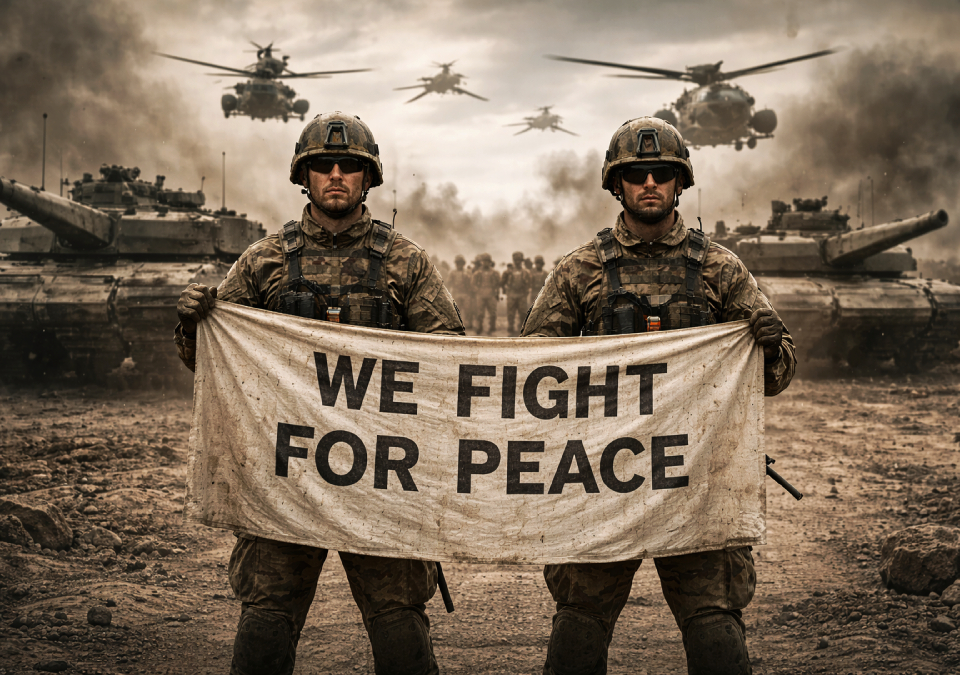
War masquerades as peace when “humanitarian intervention” becomes the cynical justification for invasion, bombing, and utter destruction. Foreign powers justify mass bloodshed by claiming to “liberate the oppressed”, when the stark reality leaves nothing but shattered families, devastated cities, and lawless ruins. The tragic case of Libya under NATO’s 2011 bombing campaign serves as an evident illustration, reducing a once-functioning state to utter chaos. Infrastructure was annihilated, water and electricity systems collapsed, and hospitals were left in ruins. The assassination of Gaddafi did not bring peace – it unleashed tribal warfare, civil war, and a brutal power struggle that fuelled the rise of armed militias and human trafficking networks. Slave markets reappeared in broad daylight, and the nation became a hub for terrorism and instability that spread throughout the region, proving the true cost of such “peacekeeping” endeavours. While Western powers claimed this a moral victory, they abandoned Libya to a decade-long devastation. Resources were plundered under the guise of reconstruction, and geopolitical chess games replaced sovereignty. The perpetrators returned home as “war heroes”, while the victims were left to bury their dead amidst the rubble – and betrayal. So ask yourself, can “peace” truly be called peace if its very definition depends on the amount of lives that must be lost to obtain it?
This inversion extends deeply into our economic realities, where predatory lending, debt traps, and corporate exploitation are defended as “economic growth” or “progress.” Entire populations are enslaved to financial servitude through rising living costs, perpetual debt, and manipulated markets. Corporations strip natural resources, displace local populations, and pollute entire ecosystems in pursuit of “development.” Governments partner with multination giants to enforce austerity while dressing it up as “modernization.” Individuals are reduced to data points and labor units, valued only for their ability to generate profit. A glaring real-world example is the 2008 Global Financial Crisis, triggered by reckless speculation, predatory lending, and fraudulent practices in the financial sector. Markets were inflated through toxic mortgage-backed securities, and when the bubble burst, it decimated livelihoods worldwide. Millions of ordinary people lost their homes, jobs, and savings, while the very corporations responsible received taxpayer-funded bailouts. Governments then imposed brutal austerity on the public – slashing healthcare, education, and pension – while corporate profits and executive bonuses skyrocketed. Countries like Greece suffered near-total economic collapse, with rising suicide rates, poverty, and social unrest lasting for years. This crisis revealed that what is paraded as “progress” often results in mass suffering when principles are abandoned for profit. Prosperity is paraded on billboards while homes are foreclosed, wages stagnate, and essentials become luxuries. What then, is the meaning of progress when it’s measured only by stock market gains while human dignity deteriorates – and who truly prospers in such a system?
These blatant inversions – where tyranny is rebranded as order, censorship as safety, war as peace, and profit as progress – are symptoms of a deeper societal sickness: the fundamental confusion between what is merely efficient and what is genuinely moral. Utility becomes the universal excuse – a corrupt logic where “the greater good” justifies any harm, erases autonomy, and suppresses truth. Rulers manipulate compassion into compliance, using collective well-being to trample individual rights. Natural Rights are reduced to bargaining chips tossed aside in political negotiations. Atrocity is normalized as long as it serves national interests or institutional stability. Over time, people lose the ability to discern right from wrong as principles are buried beneath policies. In a society where every value has a price, injustice does not just flourish – it becomes the default, and corruption is not just inevitable – it is enshrined. Order can be good, but not if built on oppression. Growth can be beneficial, but not when it exploits the vulnerable. Without principle to anchor it, utility is a weapon, not a virtue.
When this moral compass is lost, and legality becomes the sole arbiter of right, the very essence of human agency is threatened, transforming us from sovereign creators into cogs in a self-perpetuating machine. Legality does not equal morality. Apartheid was legal. Slavery was legal. Surveillance laws are legal. None are moral. Legalism creates a dangerous blind spot: “If it’s legal, it’s right.” This mindset is carefully cultivated by incessant propaganda and societal conditioning, which normalizes the insidious erosion of principle. But if legality offers no moral compass, why then do populations comply with these immoral systems? The answer lies in a complex web of fear, the powerful pull of conformity, the deliberate suppression of alternatives, and the relentless programming that distorts the perception of reality. Institutions hide their crimes behind whitewashed campaigns, corporate charity, and public relation stunts – while violating Natural Law daily. It is a profound testament to our collective forgetfulness that we, the architects of these structures, now stand in awe and fear of the very blueprint we drew. And when morality is compromised under guide of benefit, what remains of justice?
The system, once a tool, now increasingly invades the domain of individual conscience. Obedience is glorified as virtue while personal sovereignty erodes until people no longer think in terms of right and wrong, but only in terms of legal and illegal. The true cost of this shift is not just a profound internal surrender, but the very core where personal morality is silenced. It is our own willingness to compromise, to trade fundamental moral truths for perceived convenience and fleeting comforts, that breathes tyrannical life into the systems we brought into being. This does not just enslave individuals – it enslaves generations. Children are born into a world where the machine is god, where utility is worshipped, and where morality dies at the altar of efficiency. When we elevate the machine, when we grant it supremacy over our own conscience, it is our own submission that makes it a god. Morality does not die at the altar of efficiency, we sacrifice it there.
Principles are not negotiable – they are the compass by which free people navigate. When we abandon principle in favor of utility, we do not gain freedom or progress - we surrender them both. The tools we build must never dictate what is right, nor should the systems we create determine our conscience. Principle must always outweigh convenience. We must remember that we are not servants of the machine - we are its masters. You are the creator – not the subject of your creation. The machine must still answer the eternal Law of justice, truth, and freedom. The choice is always ours: reclaim sovereignty through principle, or pass down the decay of compromise. One leads to life, the other to slow, quiet enslavement.
With principle abandoned and utility enthroned, we now live in a world where the tool commands the creator, and systems justify their own existence at any cost. The following chapters will pull back the curtain – exposing not just isolated moral failures, but the very foundation of our modern world: built on lies, coercion, and systemic harm. This is no accident. It is the inevitable consequence of surrendering principle.
And it is time we see it for what it truly is.